

Executive Summary
Securing an ISO/IEC 27001 certification is a rigorous process involving multiple layers of assessment. For many organizations, the terminology surrounding the audit lifecycle—Stage 1, Stage 2, internal, external, surveillance—is confusing.
This guide clarifies the fundamental differences between internal and external audits, detailing why a proactive internal audit is the most critical step in guaranteeing success during your official external certification process.
The Business Problem: The Cost of Non-Conformity
Failing an external ISO 27001 audit (or a TISAX assessment) carries significant business penalties. It delays your ability to bid on enterprise contracts, requires costly remediation efforts, and forces you to pay your external certification body for re-audits.
The vast majority of external audit failures occur because the organization attempted to leap directly from policy creation to external assessment without rigorously testing their ISMS themselves.
Explaining the Framework: The Audit Types
The External Audit (The Certification Body)
External audits are conducted by independent, accredited Certification Bodies (like BSI, TÜV, or SGS). Their objective is to verify that your ISMS meets the requirements of the ISO 27001 standard. If they are satisfied, they issue the certificate.
The initial external certification process is divided into two stages:
- Stage 1 (Documentation Review): The auditor reviews your documentation (policies, Scope, Statement of Applicability) to ensure the ISMS is designed correctly on paper.
- Stage 2 (Implementation Audit): The auditor visits your site (or conducts remote interviews) to verify that the policies from Stage 1 are actually being followed. They will demand evidence: log files, access review sheets, and training records.
The Internal Audit (Your Self-Defense)
Clause 9.2 of the ISO 27001 standard explicitly mandates that an organization conduct regular internal audits. This is not optional; you cannot pass a Stage 2 external audit if you have not conducted a full internal audit.
Our TISAX® and ISO 27001 experts help European automotive suppliers achieve compliance within 95 days.
An internal audit is a comprehensive self-assessment conducted by someone not responsible for the ISMS (to maintain objectivity). We strongly recommend using external experts like a Virtual CISO to conduct this.
Practical Implementation: The Value of the Internal Audit
A properly executed internal audit is essentially a "mock" Stage 2 audit. It allows you to find and fix your own non-conformities before the external auditor arrives.
Finding the Gaps
If your Access Control policy states that user permissions are reviewed quarterly, the internal auditor will ask for the sign-off sheet from Q2. If the IT manager cannot produce it, the internal auditor issues a Non-Conformity (NC).
Because this is an internal audit, the organization has time to perform a root-cause analysis and correct the process before the external certification body arrives.
Preparing the Staff
External audits are intimidating. Staff members often panic and provide incorrect information to external auditors simply out of nerves. An internal audit provides a low-stakes environment to coach staff on how to answer auditor questions accurately and concisely.
Expert Insights: Objectivity is Key
A common mistake mid-sized organizations make is asking their own IT Director to conduct the internal audit. This violates the principle of objectivity. An architect cannot effectively audit their own architecture.
To satisfy the certification body, internal audits must be conducted by qualified individuals independent of the processes being audited. Engaging an outsourced consulting firm for the internal audit guarantees objectivity and uncovers blind spots internal staff may intentionally or unintentionally ignore.
Audit with Confidence
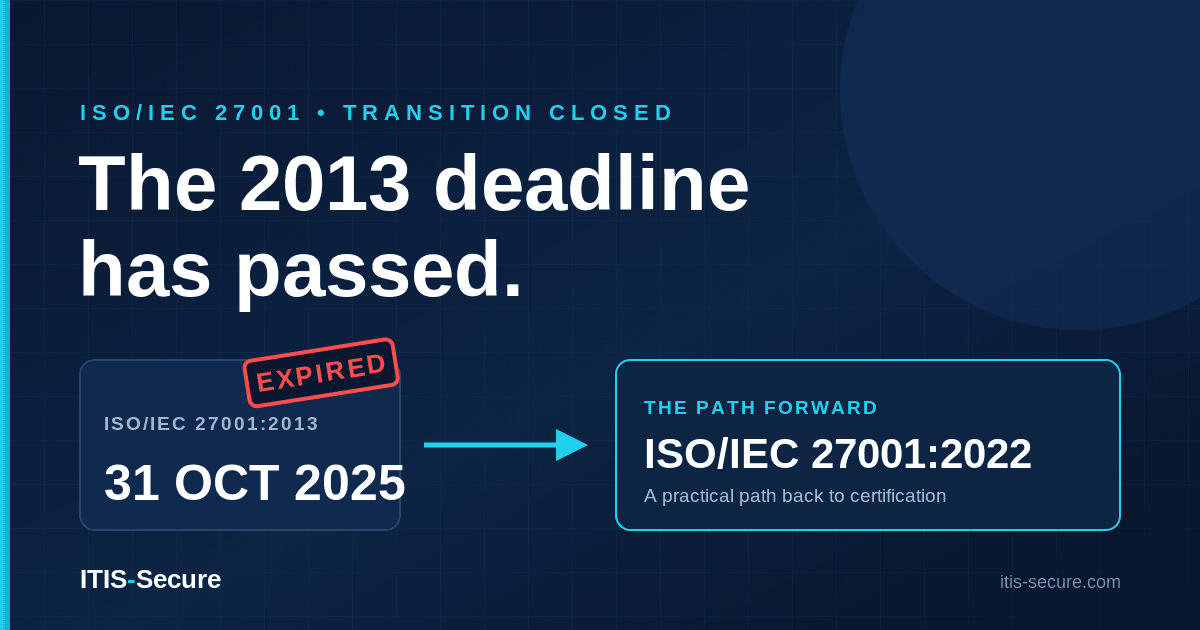
Never face an external auditor unprepared. ITIS-Secure conducts rigorous, combative internal audits designed to pressure-test your ISMS, ensuring you achieve ISO 27001 certification smoothly and securely. If your ISO 27001:2013 certificate lapsed at the 2022 transition deadline, see our practical path back to certification.

About Iulian Bozdoghina
Lead Auditor and Consultant
"Iulian Bozdoghina is a veteran cybersecurity strategist with over 15 years of experience in securing automotive supply chains and critical infrastructure. He specializes in TISAX®, ISO 27001, and the emerging NIS2/DORA regulatory landscape."