
Executive Summary
For organizations navigating the complex landscape of information security compliance, deciding between ISO/IEC 27001 and TISAX® (Trusted Information Security Assessment Exchange) is a critical strategic inflection point.
While TISAX® is derived directly from the ISO 27001 framework, the two paths diverge significantly regarding assessment methodology, industry acceptance, and physical security requirements. This comparison breaks down the fundamental differences to assist CISOs and enterprise executives in aligning their compliance roadmap with their business objectives.
The Fundamentals: ISO 27001
ISO/IEC 27001 is the globally recognized, industry-agnostic gold standard for an Information Security Management System (ISMS).
Its primary function is to establish a systematic approach to managing sensitive company information so that it remains secure. It encompasses people, processes, and IT systems by applying a robust risk management process.
Strategic Value of ISO 27001
- Universal Acceptance: An ISO 27001 certificate is recognized across almost every sector globally—finance, healthcare, SaaS, and government.
- Flexibility: The standard tells you what you must achieve (e.g., manage access control), but allows the organization flexibility in determining how to implement the technical controls based on their specific risk appetite.
- Foundation for Other Frameworks: Building a mature ISMS based on ISO 27001 provides the required structural foundation to easily adopt specialized mandates like NIS2 or DORA.
The Fundamentals: TISAX®
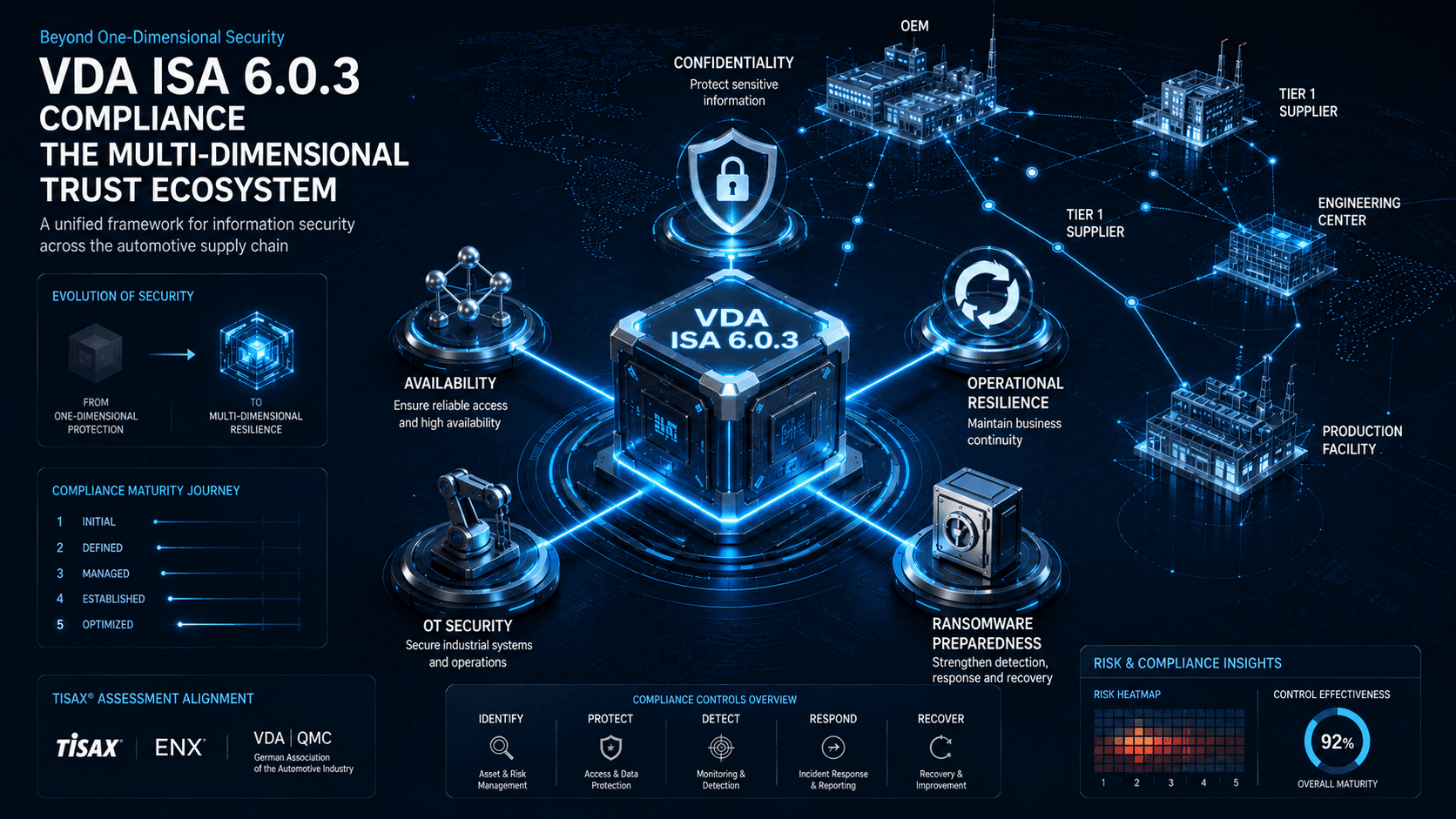
TISAX® is an assessment and exchange mechanism governed by the ENX Association, designed specifically for the European automotive industry. It is built upon the Information Security Assessment (ISA) questionnaire published by the German Association of the Automotive Industry (VDA).
Strategic Value of TISAX®
- Mandatory for Automotive: If your organization wants to supply parts, software, or services to major European OEMs (BMW, VW, Audi), obtaining a TISAX label is a strict contractual prerequisite.
- The Exchange Mechanism: TISAX prevents "audit fatigue." Instead of undergoing separate security audits from every OEM you supply, you undergo one accredited TISAX assessment and share the resulting label via the centralized ENX portal.
- Strict Maturity Levels: Unlike ISO 27001, which allows for broader interpretation, TISAX demands proof of specific operational maturity. Policies must be documented, actively followed, and historically proven.
Head-to-Head Comparison
1. The Scope of Assessment
Our TISAX® and ISO 27001 experts help European automotive suppliers achieve compliance within 95 days.
- ISO 27001: The organization defines the scope. An organization can choose to certify a specific subsidiary, a single data center, or a singular software product while excluding the rest of the company.
- TISAX®: The scope is heavily dictated by the OEM's requirements and the specific VDA ISA catalogues (Information Security, Prototype Protection, Data Protection) relevant to the data being handled.
2. The Assessment Process
- ISO 27001: An accredited auditor issues a certificate valid for three years, subject to mandatory annual surveillance audits to ensure continuous improvement.
- TISAX®: An accredited audit provider conducts an assessment resulting in "labels" valid for three years. There are no mandatory annual surveillance audits, but the initial assessment is highly rigorous. (See our detailed guide on TISAX preparation).
3. Physical Security and Prototypes
- ISO 27001: Addresses physical security (e.g., locking server rooms, restricting office access) in a standard organizational context.
- TISAX®: Includes an entire, highly specialized module for Prototype Protection. If you handle physical automotive parts or digital CAD designs of unreleased vehicles, you must implement extreme physical shielding, secure test-driving protocols, and segregated IT networks far exceeding standard office protections.
Expert Insights: Do I Need Both?
A common query from consulting clients is whether holding an ISO 27001 certification automatically qualifies them for a TISAX label.
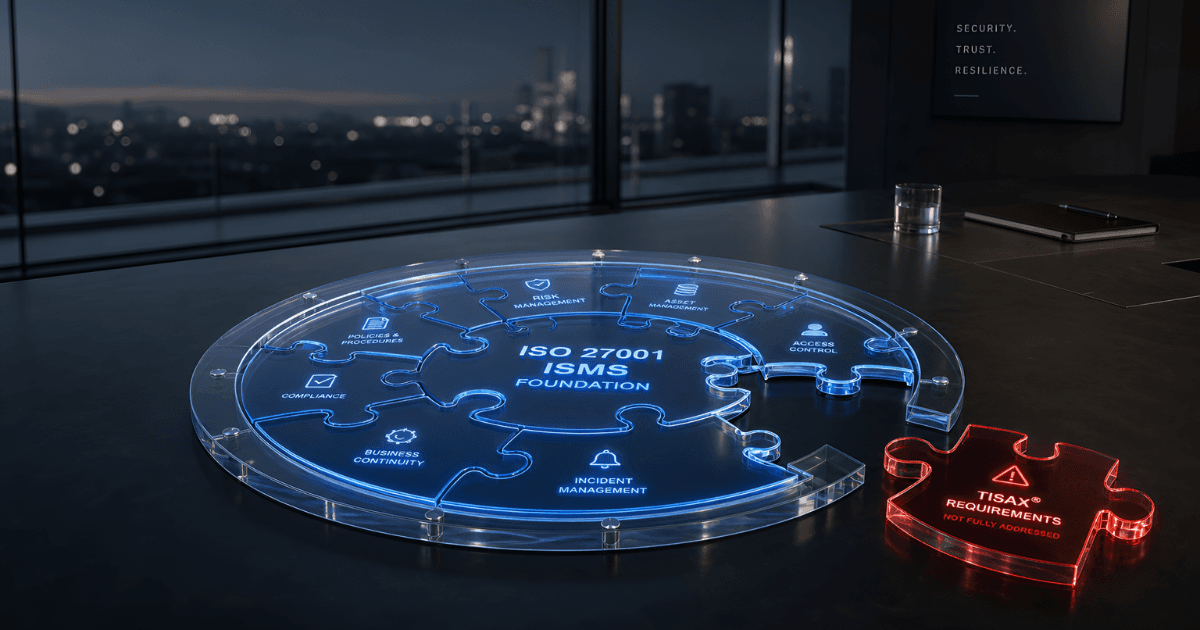
The answer is definitively no. While an ISO 27001 certified ISMS will cover roughly 80% of the core Information Security requirements of the VDA ISA questionnaire, it completely lacks the automotive-specific controls (like Prototype Protection) and the strict maturity evidence required by TISAX.
Conversely, holding a TISAX label does not provide you with an ISO 27001 certificate to show non-automotive clients.
If your customer has already told you which labels they require, the next question is usually the assessment level. Our guide to TISAX AL2 vs AL3 explains how the level is derived from your labels. And to see where you stand today, the self-service TISAX audit checklist scores your posture control by control.
The Compliance Roadmap Decision
The decision is straightforward: If your strategic growth relies on the European automotive supply chain, prioritize TISAX®. For all other technology, finance, and enterprise service providers, ISO 27001 remains the foundational necessity.
ITIS-Secure engineers ISMS architectures that satisfy both frameworks flawlessly. Contact us to chart a unified path to compliance.

About Iulian Bozdoghina
Lead Auditor and Consultant
"Iulian Bozdoghina is a veteran cybersecurity strategist with over 15 years of experience in securing automotive supply chains and critical infrastructure. He specializes in TISAX®, ISO 27001, and the emerging NIS2/DORA regulatory landscape."