
Executive Summary
For automotive suppliers, the mandate for cybersecurity has never been more complex. Today's connected vehicles contain upwards of 100 million lines of code, transforming them into mobile data centers susceptible to remote hacking.
To navigate this landscape, Tier-1 and Tier-2 suppliers must master two distinct, but complementary, frameworks: TISAX® (Trusted Information Security Assessment Exchange) and ISO/SAE 21434 (Road vehicles – Cybersecurity engineering). This guide clarifies the distinct purposes of both standards and explains how to integrate them into a holistic, cost-effective compliance strategy. For a procurement-side view of what OEMs actually require, see automotive supplier TISAX requirements.
The Business Problem: Two Facets of Automotive Security
The confusion among many engineering and IT directors stems from attempting to use one framework to solve two different problems.
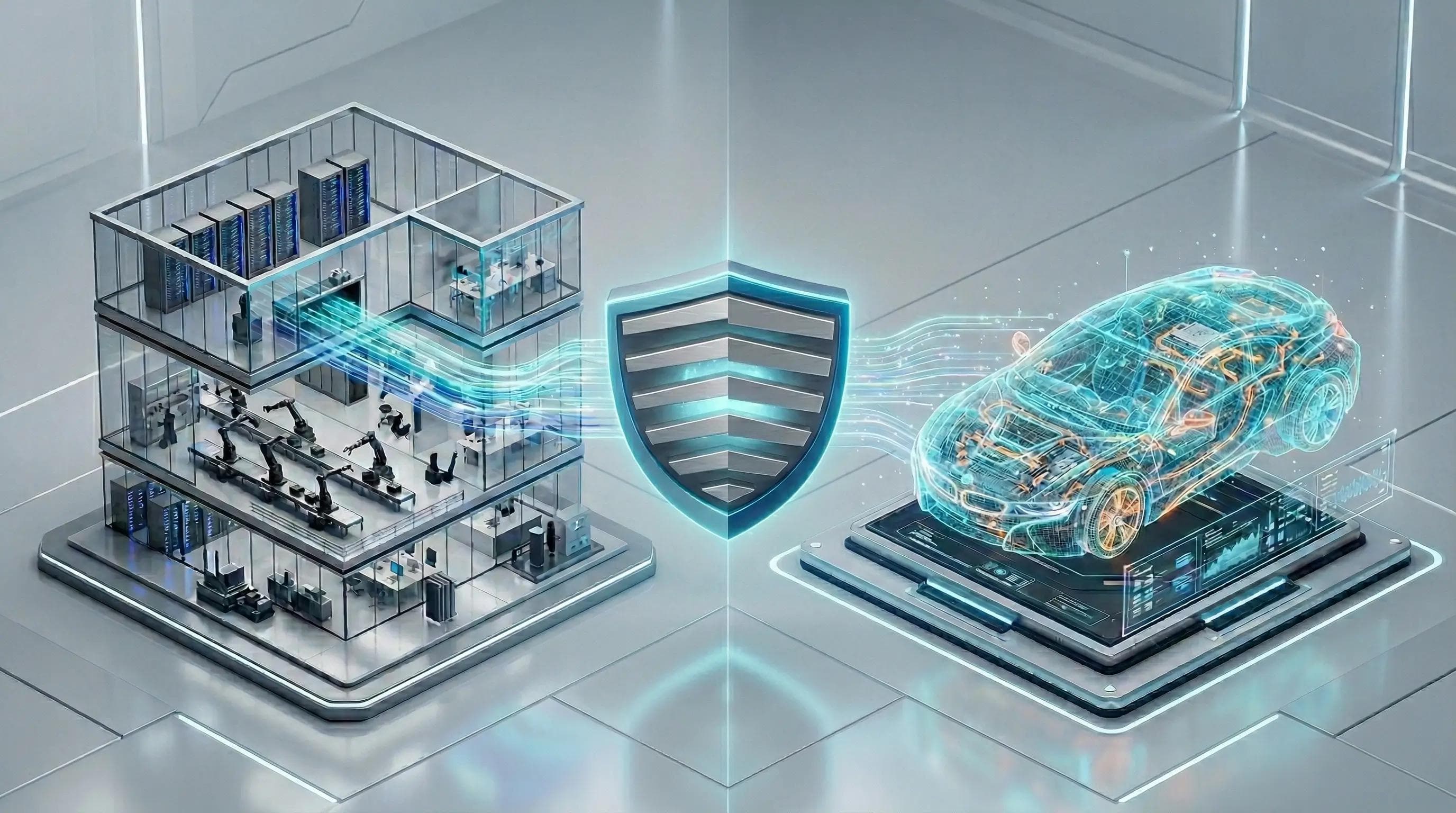
- The Enterprise Data Problem: When an OEM like BMW shares unreleased CAD drawings or customer telemetry data with a Tier-1 supplier, they need a guarantee that the supplier's corporate network won't be breached by ransomware, leaking those designs to competitors.
- The Vehicle Engineering Problem: When a Tier-2 supplier manufactures a braking control unit or an infotainment module, the OEM needs a guarantee that a hacker cannot remotely exploit that specific hardware/software combination to take control of the vehicle on the highway.
Understanding this division is critical.
Explaining the Frameworks
TISAX®: Securing the Organization
TISAX is designed to secure the supplier's organizational environment. Based heavily on ISO 27001, it mandates secure networks, strict access controls, security awareness training, and the physical protection of prototypes.
If TISAX is properly implemented, a hacker cannot steal the blueprints for the new braking system from the supplier's corporate servers.
ISO/SAE 21434: Securing the Product
ISO/SAE 21434 is designed to secure the electronic systems embedded within the vehicle itself throughout their entire lifecycle. It dictates how automotive components must be designed, developed, tested, and decommissioned with cybersecurity inherently built-in.
It requires Threat Analysis and Risk Assessment (TARA) during the concept phase, secure coding practices during development, and continuous vulnerability monitoring after production.
Our TISAX® and ISO 27001 experts help European automotive suppliers achieve compliance within 95 days.
If ISO/SAE 21434 is properly implemented, a hacker cannot remotely manipulate the physical braking system while the car is moving.
Practical Implementation: The Synergy of Integration
Treating TISAX and ISO/SAE 21434 as separate siloed projects creates massive operational overhead and duplicated effort. A strategic compliance approach integrates the common domains of both frameworks.
Step 1: Unify Information Security Management
Both frameworks demand foundational security management. The organizational policies, HR security protocols (background checks, onboarding), and foundational IT security rules established for TISAX AL3 serve as the necessary corporate backbone to support the engineering requirements of ISO/SAE 21434.
Step 2: Shared Incident Response
While TISAX focuses on enterprise IT incidents (e.g., an employee clicking a phishing link), and ISO 21434 focuses on product vulnerabilities (e.g., a newly discovered flaw in a Bluetooth component), the underlying reporting structures should be integrated. A unified Incident Response Playbook ensures that a security event originating in the engineering department is properly escalated to the executive level.
Step 3: Integrating Secure Development Lifecycles (SDLC)
Under TISAX (and the updated ISO 27001:2022), secure coding and development environments are mandated. ISO/SAE 21434 provides the exact, rigorous engineering specifications for how that secure development must occur for automotive components. By applying 21434 methodologies, you inherently satisfy the TISAX development controls.
Expert Insights: The VDA Automotive SPICE
For software-heavy automotive suppliers, achieving ISO/SAE 21434 compliance requires integrating cybersecurity processes directly into Automotive SPICE (Software Process Improvement and Capability Determination). Attempting to bolt cybersecurity testing onto the end of a product release cycle guarantees project delays and audit failures. Security must be shifted left—integrated directly into the initial requirement gathering and system design phases commanded by A-SPICE.
If TISAX is the half of the equation your customer asks about first, the self-service TISAX audit checklist scores your current posture against the VDA ISA controls.
Delivering Secure Automotive Innovation
Balancing rigorous TISAX label requirements with complex vehicular cybersecurity engineering is a monumental task. ITIS-Secure provides deep expertise across both frameworks, helping automotive suppliers streamline compliance, reduce audit fatigue, and engineer secure mobility solutions.

About Iulian Bozdoghina
Lead Auditor and Consultant
"Iulian Bozdoghina is a veteran cybersecurity strategist with over 15 years of experience in securing automotive supply chains and critical infrastructure. He specializes in TISAX®, ISO 27001, and the emerging NIS2/DORA regulatory landscape."